Collage work

Teenage Days of Discovery, Mixed Media on Canvas Board


I’ve recently been experimenting with collage. I’m inhabiting my inner Lee Krasner who often tore old canvas work and reinvigorated them as collage pieces. I’ve taken this idea and mashed it up.

The process

Taking on my on-going work with strata and palimpsest, I took some canvas pieces and paper compositions  I wasn’t happy with, tore them up and drew all over them with paint, permanent and metallic marker.

I then took some other canvas board and canvas pieces I’d already worked on and layered them with gold and silver leaf and wax paper. I then applied strips of my ‘customised’ canvases and paper pieces.

Once the layers were fixed, I made further marks using paint, crayon and marker to bring the pieces together.

The morning journey to school, mixed media on canvas. Ella Johnston artist
The morning journey to school, mixed media on canvas


The purpose

These were artworks made in my recent past.  I wanted the pieces to reflect my deep past. Ultimately my childhood. Traditional nostalgic artworks and memoirs about childhood are so often depicted in some kind of rural ideal.

I didn’t grown up in a rural setting. I grew up in Hackney.  That was my childhood landscape.

Memories of Home, mixed media on canvas board


I wanted these collages to reflect the eclecticism of this environment. The reflections of rain on pavement, the graffiti tags, the flora and fauna of the Regent’s Canal, the tall buildings, the quality of light. The noise and the silence.

I also wanted these pieces to be about love.  So I took tremendous care in putting them together.


Memories of Home, details

As the past is a construct. These pieces are deliberately fragile as I am an unreliable narrator. It’s just my memories. My sensations and my truth.

They really deal with my journeys to and from places. I walked a lot in my childhood. We didn’t have a car.  While we lived centrally we had a bit of a walk to Old Street tube and the Angel.  There were a lot of long streets and canal meanders. And a lot of clashing architecture. And it’s those contradictions and juxtapositions I wish to navigate in these works.

Childhood Landscape, mixed media on canvas board

Wordless text and mark making

ELLA JOHNSTON INK ON PAPER

My current work is an exploration of mark making. The marks are a kind of text. Some of the pieces are specifically asemic. They are an exploration of the types of marks I make when writing.

Asemic text, Ella Johnston artist

This is actually very personal. Because of the way I held my pen when I was a kid, I was bullied by a teacher for my writing. Ever since then I’ve been strongly protective over my writing and my mark making. And it’s something that I’ve needed to explore. It’s something that I’ve had to think about from an early age – the marks I was making and how I was making them.

Asemic poem ella johnston

It’s quite a psychological thing for me. I like my writing. People comment on my handwriting. What is ‘my own hand’? What is it to play and experiment with that? Asemic poetry really interests me because it’s about making marks and enjoying these marks without actually writing a text that people can immediately read. But the visual language of handwriting can be found within my own artistic practice. I also once I had my handwriting studied by a graphologist. She noticed all the flourishes and was alarmingly accurate with her analysis. Regardless of what words you write, the marks you make give the game away. I employ all of my handwriting and gestural mark-making in the pieces.

Asemic modernity Ella Johnston


The pieces are definitely wordless texts and there’s a dialogue between the different marks. But they’re also simply about being in the moment when the artwork is created. I might have my reflections or even a particular agenda, and it’s also in some ways a projection of the future, but really it’s simply about the moment, the now, in which the artwork is made. I don’t want to impose my own narrative. The question is just about what it means to make a mark, and to make those marks on the paper.

Water Meditations Sea Glass I, ink on Awagami Factory Bamboo washi paper Ella Johnston

With different papers you get different reactions. I love the experiment of paper. The surface is as important as the ink or the paint. A cheap watercolour paper, made without bleach so it’s greyish in tone, produces a certain effect. Some papers absorb liquid too much, some resist it. A washi inkjet paper and a fine washi rice paper give different results. Some absorb the ink very quickly, some completely blot it. 

Lifeforce poem, Ella Johnston

With a very fine paper, you’ve got to be careful if you want a solid line. You’ve got to be light, like you’re barely touching the paper, because if you apply any kind of pressure or wetness, it’s going to suck it up. It’s really delicate. Or you might use a good quality, heavy paper, and they’re so dense, but they hold colour so well that you’re challenged to be decisive in the marks that you make. On some papers the black ink buckles the paper, it sits and stays shiny on it, raised in relief. Some papers can look so frail against this force of the black. You have to work with that. You’ve got to work with the ink and the paper as equally important components.

Memory of days past, Fraggle, ink on Fabriano UNICA Printmaking Paper

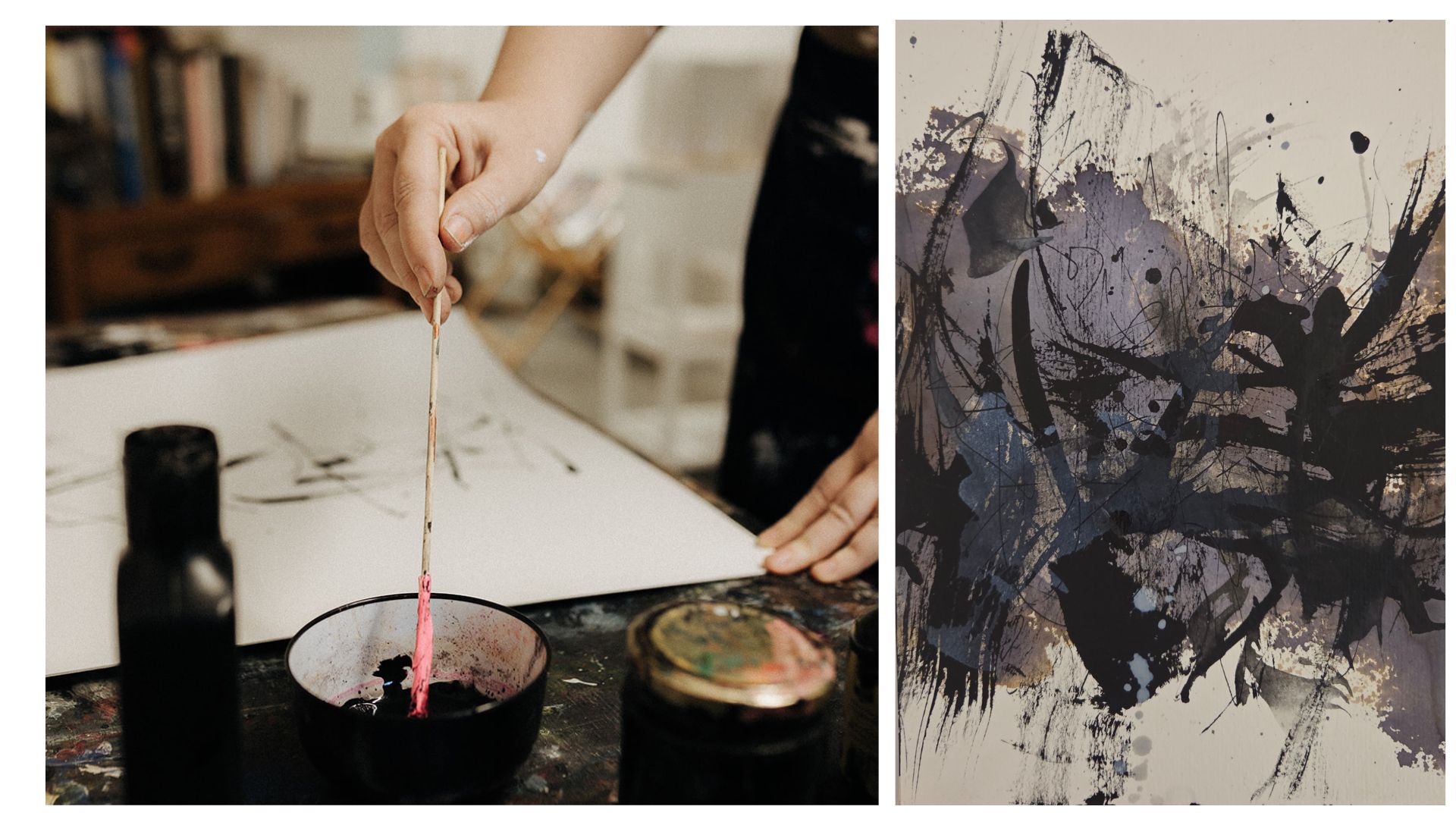
My mark making tools

ELLA JOHNSTON ART STUDIO

It starts with playing.

I have to let intuition guide me a little. If I use a square brush, I know that I want to explore something about form, with spontaneity and looseness. It involves memory and even muscle memory of making those marks.

Ella Johnston, artist. Photography Nathan Jones
Photography Nathan Jones


If I pick up a pen I know I want to be precise, when I use a particular brush I want to be expressive in a different way. I’ll know it instinctively when I start.

Then, once I introduce the colours, form and composition, I’ll know what theme it’s taking. It can almost be like you’re in a trance, a slightly different level of consciousness. I’m alert, and the marks I make are deliberate, but there’s also a flow, a dance, which you don’t have to think about, and it just happens.


Memory of days past white-noise feedback ink on paper, Ella Johnston

If I’m holding a large square brush, how do I make that curve? How do I make those gestures, those swooshes and dashes that look like they’re moving even if they’re static? They’re still but they’ve got movement, like they’re about to fly. Or a mark that’s got to be so solid. I’m not thinking hard about it. If I’m too diligent it doesn’t work. I’ve got to be purposeful, but at the same time I’ve got to let go and be free. Focused but free.

Ella Johnston making marks

I’ve always liked ink. I like the unruliness of it and that you’ve got options to use a pen or a brush, and to water it down to create washes. There’s a lot of scope. 

Water Meditations Sea Glass III ink on Awagami Factory Bamboo washi paper, Ella Johnston

In the past few years I’ve also experimented with different types of mark-making tools. I’ve used feathers, and reeds from the marshes near where I live, and broom, and the seed-heads of teasel. They make different types of mark. And there’s something more fluid about inks than paint when you make those marks. I like its immediacy, its unforgiving nature.

In the depths, ink on Fabriano watercolour paper. Ella Johnston

I use a lot of Japanese calligraphy brushes of different sizes, and square brushes, and I also make my own tin-can pens from old soft drinks and beer cans. They’re really a calligraphy tool but, like with the calligraphy brushes, I use them for drawing and mark making. I like the playfulness I can achieve with the tin-can pens, the variation of line, and when I combine that with the softness of a brush it’s quite interesting. 

Asemic poem large scale, Ella Johnston artist

If I’m using soft round brushes, I might know that I want to press the full weight of the brush down and drag it. Or I might want to work with the tip of a calligraphy brush to produce very fine lines. With a tin-can pen you’re not going to get a consistent line. It doesn’t hold ink in that way. You don’t control it in the way you do with a brush.

Eucalyptus Ella Johnston

I often use the tin-can pens to create a kind of central column in the work, which is a kind of upwards life force. There’s a journey there, a sense of collision and violence, but an upward momentum and force. The hard lines and edges of the pen strokes, in contrast to the soft lines of the brush produce collisions. Then I’ll add extra shapes, circles or blocks of colour. And in doing all this there’s a search for balance, beauty and harmony. There’s a mood. It’s a mood of stillness and movement and the contrast between them. 

The Observations of Angelus Novus, The Storm, Ella Johnston

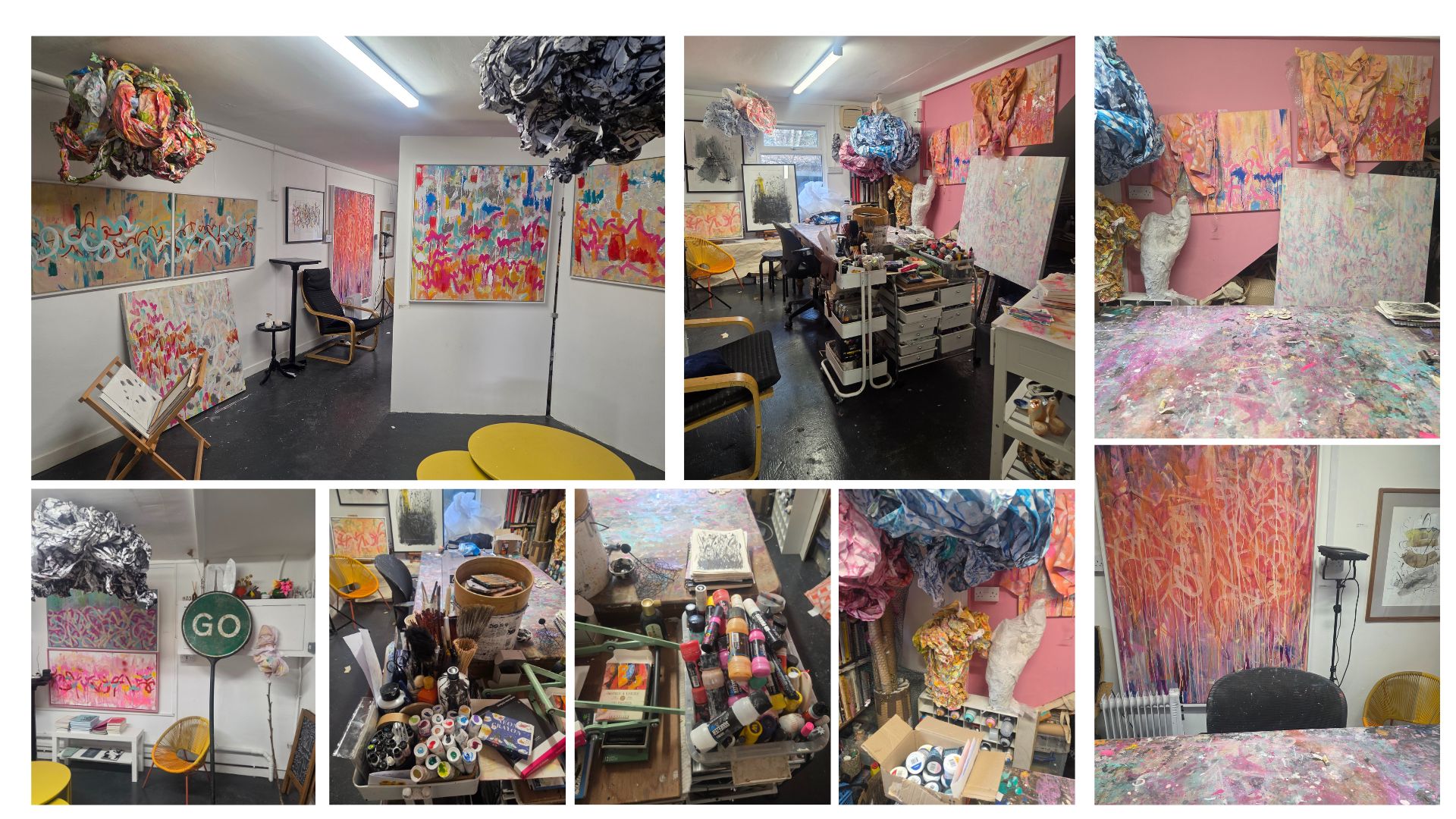
A look inside my artist studio

Ella Johnston Artist Studio

Ella Johnston Artist Studio

As I said last time that I’d put my personal vanity aside to give you a look inside my artist studio. So here I am, looking a bit tired, in the studio!

Ella Johnston, artist. Photography Nathan Jones
Photography Nathan Jones

I love having a large dedicated space where I can really make a mess, explore mark-making and create both large and small-scale works.

I’ve had the keys to the studio for a whole year today! So it’s apt I’m posting this now.

Ella Johnston Artist photography Nathan Jones
Photography Nathan Jones

I have certainly filled the space and made it my own. I’m always amazed whenever I get a new space that my work rate goes up and my desire to experiment and entertain new ideas increases dramatically.

Ella Johnston artist, photography Nathan Jones
Photography Nathan Jones

It really can’t be understated what a luxury, yet necessity for me (not one I can always afford), it is to create an environment that is totally focused on creativity. A space where I can see my tools and materials and be inspired by their presence. The colour, texture, mark and intensity possibilities of each instrument and surface. The space to play, to reflect, to research, read and generally be in space where your art practice is central.

Ella Johnston studio, artist. Photography Nathan Jones
Photography Nathan Jones

I’m lucky to have creative job that adds to both my artist life and my employment life. But sometimes those lines can get too blurred. Gaining that physical distance from the everyday work to concentrate purely on my artistic project is a gift indeed. And one I don’t take for granted.

Ella Johnston, artist materials. Photography Nathan Jones
Photography Nathan Jones

What do I do in my studio? Well, some days I’ll go in switch on the radio or some music and simply play with my art equipment. I’ll experiment, make mistakes and even have the occasional breakthrough. Other times I’m deeply immersed in a project or series, deep into creating my work. There are some times where I’ll sketch and work out ideas. And there are days where I’ll read, make notes and look out the window.

Ella Johnston, artist materials. Photography Nathan Jones

The space used to be a butchers, which is hilarious because I’m a vegetarian! From the get-go the studio has always had an incredible energy to it. This was very important to me as I felt immediately comfortable in the space – even before I filled it with the furniture, equipment books and little things that inspire me and make me feel safe.

Ella Johnston Artist Studio photography Nathan Jones
Photography Nathan Jones

I was so pleased to recently invite the photographer Nathan Jones into the studio to take some photos of me working. It was lovely to welcome him into the space and get a quality record of what is a very special and rewarding period of my creative life.

Ella Johnston, artist. Photography Nathan Jones
Photography Nathan Jones

New book and art installation

Magma Ocean Young Moon Dunlin Press Ella Johnston art

The publishing company run by myself and poet MW Bewick, Dunlin Press, has just released a small pamphlet A Study of a Long-Lived Magma Ocean on A Young Moon. We thought this new book presented a great opportunity to use my new gallery space as a way of making the book ‘bigger’ with an accompanying art installation.

A study of a long lived magma ocean on a young moon, ella johnston and martin bewick
This 36-page pamphlet is a collaboration with poet MW Bewick and me. The latest project from our creative partnership showcases asemic poetry pieces by me and a long form poem by Bewick.

A Study of a Long-Lived Magma Ocean on a Young Moon, Ella Johnston and MW Bewick. Dunlin Press

The first edition of fifty is individually numbered and comes with a signed artist postcard.

Window feature art installation, Dunlin Press

We were so taken with the concept of the pamphlet – of life and movement in all kinds of landscapes and locations. We were inspired for the project to have a life and presence beyond the book.

A Study of a Long-Lived Magma Ocean on a Young Moon, Ella Johnston and MW Bewick. Dunlin Press

I took the asemic poetry pieces I created for the book and made them large scale. I was inspired by mark-making and wordless written language, but the large pieces were also influenced by modernist stained glass window designs and religious scrolls.

New book and art installation, Dunlin Press

Asemic poem large scale, Ella Johnston artist

Large Asemic Poem, Ella JohnstonWe wanted the new book and art installation to be a full experience. So MW Bewick created a soundtrack, available on Band Camp to accompany the piece. I also created some ceramic relics for the project.

A study of a long-lived magma ocean on a young moon, relics by Ella Johnston

You can buy the book at the Dunlin Press shop, you can download MW Bewick’s Young Moon soundtrack at the Dunlin Press Band Camp page. And if you’d like to see the show then please get in touch. Viewings are currently available by appointment.

Ella Johnston art studio and gallery


New studio and gallery

Ella Johnston Artist

Well this is embarrassing. In September 2020 I vowed to write more blogs, but life certainly got in the way.

A lot has happened; anyone who knows me well will know that life has been somewhat full-on recently. But one of the wonderful things that has happened is that I have a new studio and gallery space.

Ella Johnston new studio and gallery space

I couldn’t be happier with the new studio and gallery. It’s in Wivenhoe and a mere 11 minute walk (yes I have timed it) from home. It has windows (a first for me studio-wise) and it gives me plenty of space to not only make a mess but to actually show my work. It really is Ella’s Place!

Ella Johnston art studio

I took the keys back in July 2021 and I feel like this is the space I’ve been searching for my whole life.

It’s an immense privilege to have it and, as is pretty much always the case when I get a new working space, I’ve become incredibly prolific in my output over the past 12 months. And, as you can see from the image above, I’ve returned to working on canvas as well as paper. I will never end my love affair with paper.

Ella Johnston art studio and gallery space

The gallery space in the front of the studio is a really exciting development. It means I can look at my work and assess it in a gallery style setting.  And it’s great for events like the Wivenhoe art trail.

Ella Johnston art studio and gallery

Having an art studio and gallery also provides a fantastic opportunity for me to put on some stand alone shows. It means I can also explore more creative installation style opportunities for myself and my work with Dunlin Press. I’ll post about one such project that I’m really proud of later in the month.

Dunlin Press books Ella Johnston
Dunlin Press books

The space also allows me to reach out to other creatives.  The art studio and gallery is a brilliant professional setting to meet and talk about creative practice. It enables me to  support other practitioners by providing showcase opportunities. I’m currently showing off the work of Tilt Ceramics (full disclosure Tilt Ceramics is my very talented sister Lucy Johnston).

Ella Johnston Tilt Ceramics

I’ll post some more images of me in the studio next week. I had some professional images taken of me working in the space. So I’ll leave my personal vanity aside and post these up later for you to see more of the working space in action.

Ella Johnston art

As I’ve been more prolific in my output, I’m going (and I promise I really am) to write a bit more about my work and my practice. So more from me soon, honest!

Washi rice paper work

Semi drawing on washi rice paper Ella Johnston

Wish, ink on rice paper Ella Johnston

Over the past two years I’ve expanded my artistic practice into ink drawing. I’ll be sharing lots of posts on this over time but I wanted to talk about a wonderful discovery made during this new and continuing phase of my work. So here’s an intro to my adventures in washi rice paper.

Goat willow ink on washi rice paper Ella Johnston
Beautiful, beautiful paper

I have a real love for all kinds of paper, both as an artist and in my ‘other past life’ working as a magazine editor. I can talk for hours about the virtues of weights, textures and paper pressing techniques. Don’t get me on shades of ivory, cream and white!

Normally I have always opted for heavyweight art paper, and for certain works I always will. However, one day, meandering around an art shop in search of some inspiration I saw a pad of 80gsm rice paper and thought ‘hmm, where’s the harm?”. I think I subconsciously needed a new challenge, something to expand my practice and challenge me a little bit.

Now, if you’re not familiar with ‘gsm’ (grams per square metre) a simple guide is something like 80gsm is really thin, fragile and delicate when something like a 300gsm is thick, robust and heavy.

Hope, ink on rice paper Ella Johnston

Washi paper and the art of sumi-e

Having already experimented with lots of mark making tools in ink I had already been working with Japanese calligraphy brushes. Another accident really as my sister got me some when she was away in Japan. They are an absolute joy to work with and I am going to write another post concentrating on those, so look out for that.

Semi drawing on washi rice paper Ella Johnston

I wanted to have a go at using the brushes (and some of the traditional ink pens) with this very delicate paper.

The paper is so very delicate and super absorbent. Which means it is completely unforgiving – the mark you make is the mark you make. I love the spontaneity of this, and having bought some more washi rice paper at a range of higher gsm weights, the paper still holds on the ink immediately so you have to work quickly and with conviction.

Zen buds harmony, compassion Ella Johnston

A moment in time

I love the fact that you have to work quickly on this surface – to be the paper feels like it really captures a moment in time. It sounds silly but I work with this paper with a view that it’s the artistic equivalent of amber. Any little ink drop, drip and accidental ink mark or line is absorbed and preserved. You can also be creative with it and draw with water, before seeing the alchemy that takes place as you touch the water marks with ink.

Ink flowers Ella Johnston

While you have to work quicky, I have had to think slowly when working on this surface. It’s an incredibly therapeutic process as I have to really consider my marks and be deliberate in your artistic choices. I think this results in very mindful work. Though I started with black ink, I’ve expanded to explore various forms in colour with this paper, again with quite pleasing results.

Golden Allium ink on washi rice paper

I am delighted by the spontaneous nature of the pieces I’m also pleased by their quietness. In my opinion they are very gentle, considered pieces and I like this. I feel that the work reflects the contemplation and mindfulness I utilised when making them.

I’ve made both abstract ink works and botanical ink drawings with this practice and I’ve used some of the work I’ve made in this manner for some of my cards and prints.

I’m keen to explore further the creative possibilities of working with what is a relatively new material for me.


PORT PIECES: Abstract ink works

Ella Johnston Ink Landscape Images

I’ve been recently working on a series of abstract ink works for a new book from Dunlin Press.

Ella Johnston Ink Landscape Images

The book, PORT, is an anthology looking at the subject of ports. The publication essentially explores places where ‘here’ contacts ‘there’; where known and unknown meet; where perceptions of possible experience are expanded. It features essays, interviews, stories and poetry – I’m very excited to be working on it.

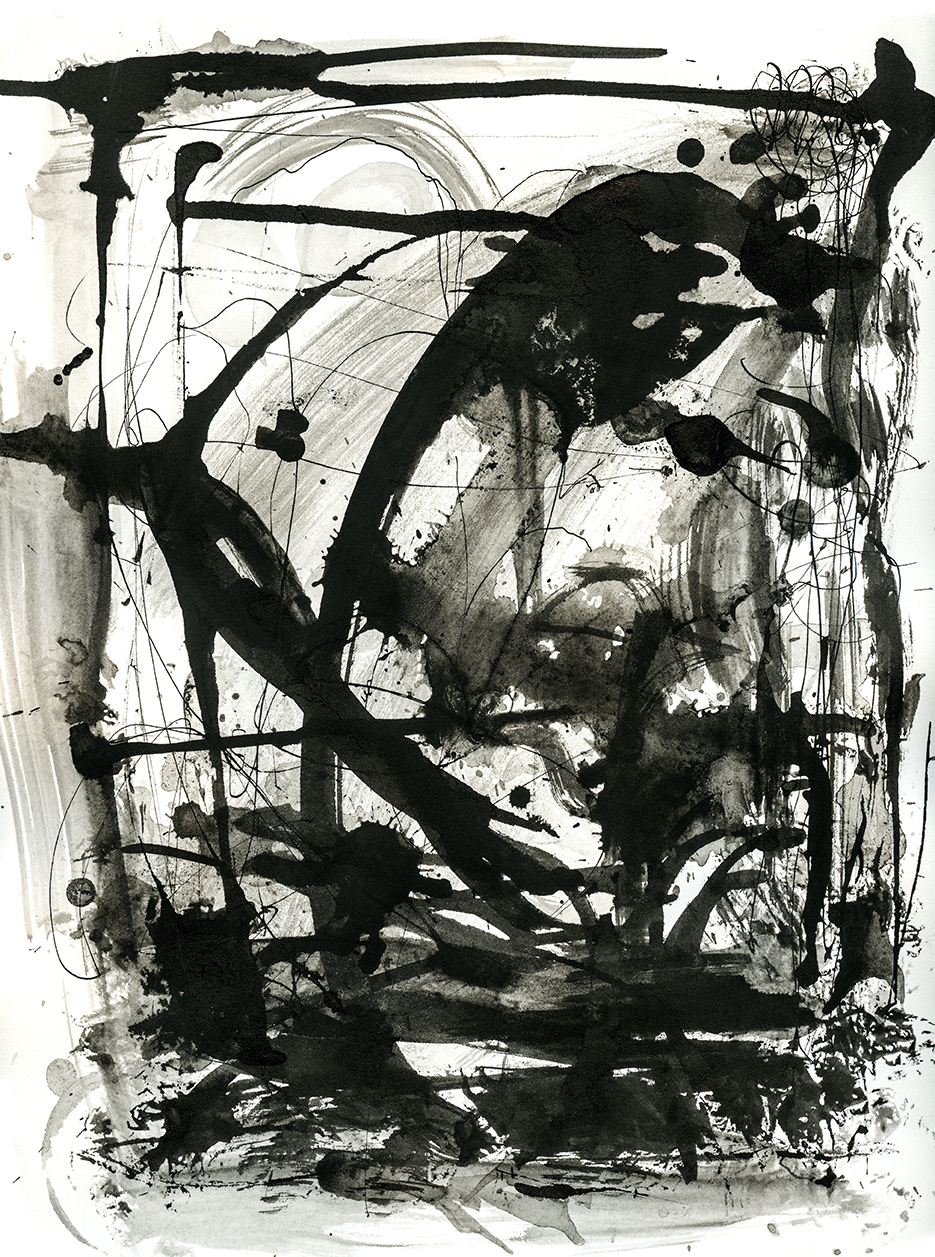
PORT PIECES: Abstract Ink landscape, Indian ink on Arches watercolour paper, Ella Johnston

I thought long and hard about this project. I wanted something that reflected the character of such places. Because these locations by their nature are scenes of transition, movement and trade, I needed to convey their shape-shifting essence.

I pondered the medium and colours I was going to use for the pieces. I needed movement, flow and immediacy so I stuck with inks, my current tool of choice.

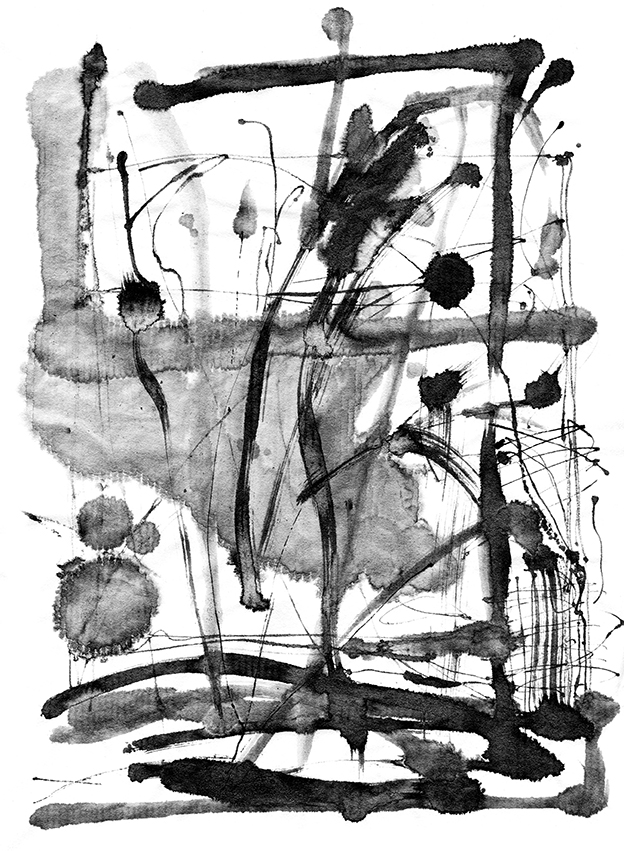
PORT PIECES: Abstract Ink landscape, Indian ink on Arches watercolour paper, Ella Johnston
So I approached these compositions as palimpsests; each quick application of ink acting as layers of stories, activities and histories coming together. I played with colour initially but settled on black and white arrangements as I felt they were starker and more visceral.
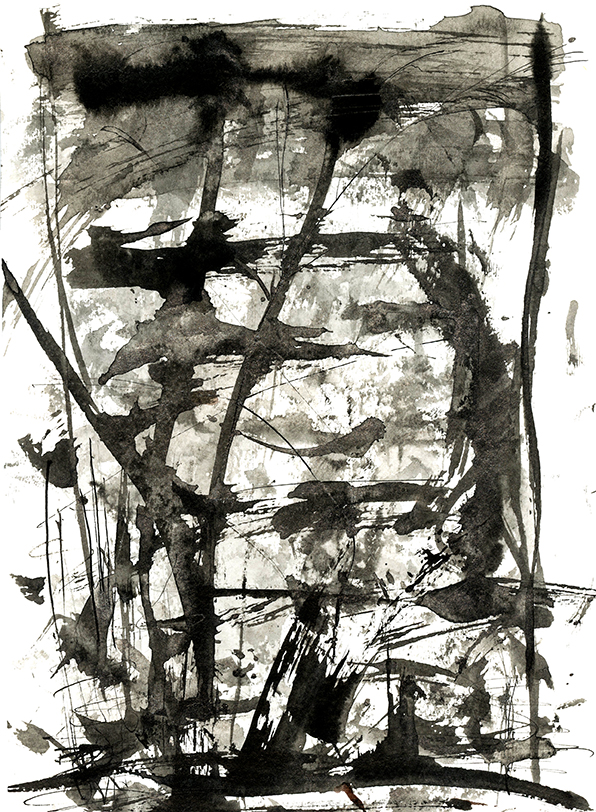
PORT PIECES: Abstract Ink landscape, Indian ink on sumi rice paper, Ella Johnston
I also experimented with the surfaces I applied my abstract ink works on. My paper selection is an integral part of every original piece. So I mixed it up a bit, using sumi rice paper, Arches smooth hot-pressed and textured cold pressed Arches watercolour paper. Every surface produced very different results as each paper type absorbs the ink washes, marks and strokes completely differently.

PORT PIECES: Abstract Ink landscape, Indian ink on Arches watercolour paper, Ella Johnston

The abstract ink works will be featured as book illustrations, with a selection being printed as limited edition fine art prints and postcards as a companion to the publication. The book is being launched in the autumn and I’ll be sure you keep you updated on its progress here.