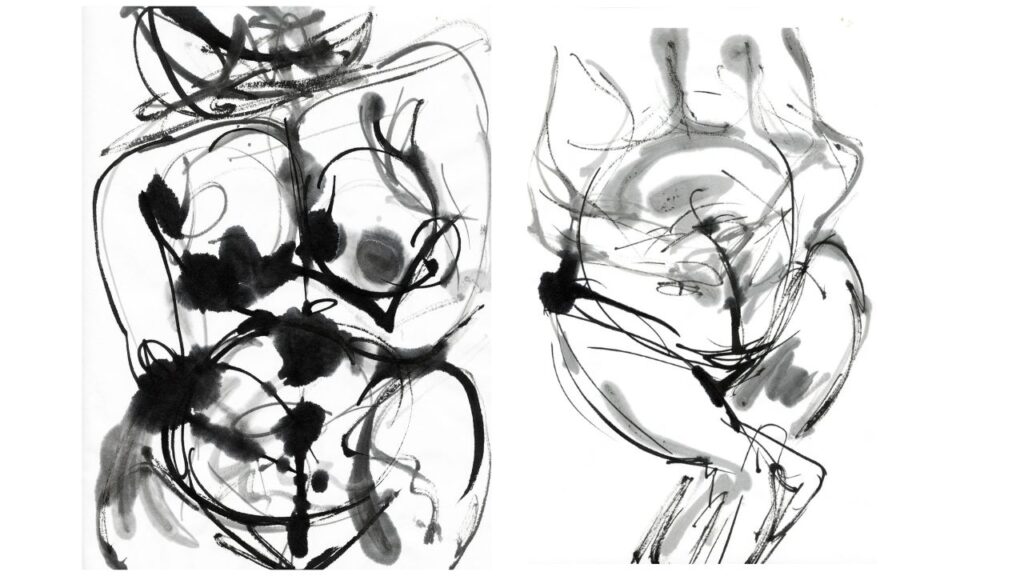
Drawing is fundamental to my art practice. It’s where I start and it’s where I have always found my peace.
Much of work hangs on mark-marking and composition, even when I’m distorting it. This begins with both observational drawing and drawing from memory.
Drawing allows me to be curious and adventurous in my use of tools and surfaces. The practice grounds me as I watch things literally take shape.
I often go into a trance-like state when I draw. I am totally focused on my hand/eye connection and what is going on when I apply my pen/brush/pencil/feather/stick etc to any given surface.
My drawing can be abstract or figurative. It gives me the opportunity to ‘figure’ out what’s in my head. It often allows me work out what I’m trying to say.
Drawing for me is an intimate and meditative act. In the worst times of my life, drawing has been my way of healing.
The alchemy of drawing holds a fascination for me that will I doubt will ever leave me.
Asemic writing is ais a wordless open form of writing.The word asemicmeans “having no specific semantic content”, or “without the smallest unit of meaning”.
Moon Poem, ink and watercolour
The non-specificity of asemic writing creates a vacuum of meaning, allowing the ‘reader’ to fill in and interpret.
Ghost poem, marker on paper
Outside of my artistic life, I have made a living as a journalist and marketer; writing and clarifying meaning. Using specific words and language to appeal to target audiences. I love the idea of stripping away explanation and specifics, using ‘text’ to create a mood or vibe.
Home poem, Ella Johnston
I compose my asemic work like a traditional poem in a long column. I also like to present the poems as long thin scrolls that evoke a feeling of a non-denominational religious text.
Far away poem, Ella Johnston
The visual language of handwriting could be found within my own artistic practice. But I like the idea of making art with the form of a written piece but using the gestures and marks of handwriting to create wordless poems.
A little look back in time to my Summer 24 paintings…
They are inspired by my teenage years; growing up working class in central London surrounded by dance culture and graffiti while studying art history and burying my head in literature of the past.
They are a love letter to where I grew up and the curiosity and anticipation I felt at that time.
A central theme of my work is one of the palimpsest – a manuscript or piece of writing that has been covered and written over again and again over time. My paintings are the most obvious example of this line of inquiry. Layers and layers of paint are built up then finally I ‘commit’ to ‘writing’ over the paint. I then create layers of ‘text’ or ‘tags’ across the canvas. It marries my fascination with the process of painting and my recent investigation into asemic poetry and writing.
I’ve been recently working a series of 3D projects; on paper sculptures and some fabric and chickenwire objects.
These works are about process, labour, truth and creating beauty from cheap materials.
For my paper pieces I saturate rolls of paper with layers of drawings, marks, form and colour using watercolour ink. Often I will include some “Easter eggs” such as landscapes, portraits and written messages in these layers.
The process is an exercise in patience, dexterity and duration; I work on a whole roll, rolling each section out to work on and arrange so there’s minimal sticking and contamination. I cover both sides of the paper, so I have to leave each side to dry before I construct the pieces.
Paper sculptures: disrupted conversations
These pieces investigate the ideas of truth and memory and how they can be distorted, changed and reshaped. The pieces also consider the cyclical nature of stories and history.
The narrative is interrupted with the twists and folds of the paper around the circle.
These interruptions, repetitions and overlapping created by the process create some really interesting shapes and marks. There is a deliberate deviation from the original intention of these marks. I want to create a feeling of never quite knowing where one mark ends or another begins and reframing the original ‘image’. Colour is also integral to the pieces. Again, it’s about what we interpret from certain colours. I feel the black and white compositions are very different from the earth tones, and the blue tones vary in mood.
Paper sculptures: vulnerable parcels
My intention for these structures is to create something very fragile and frail that is ambiguous in form and evokes a sense of the uncanny.
These parcels can be cradled in your arms, can be displayed vertically, or piled up. I needed them to appear exposed and tactile and illicit some complex feelings.
Again, the crumpling, wrapping and folding of the paper distorts and interruptions the original flow of the paper painting. But the way these forms have been assembled creates a different narrative and mood.
Constructed resilience
I read recently that many dwellings in Basra, Gaza and Syria are now held together by corrugated iron and chicken wire.
I wanted to make work that reflected precariousness of life and the resilience of people in the most terrible of circumstances. I constructed some organically shaped forms from chicken wire and weaved silk through those forms. I hand-painted the silk with ink that seeped into the material and became part of the fabric.
The work isn’t specifically about war-torn areas, rather the pieces examine the fragility of life and how we get through it. The contrast between the soft, yielding fabric and the hard rigid wire seek to reflect our human vulnerability, beauty and strength.
I’ve just opened a solo show at Harwich Arts and Heritage Centre, where you can see new paintings and 3D pieces.
I’m guessing the building was originally an old school. I’m showing in what I think was the old assembly hall, but it’s now public library and community space. It’s not your typical white-cube gallery, and that’s part of the charm.
THE SPACE
The space immediately brought back memories of my secondary school days at Maria Fidelis in Camden. Shiny tiled floors, picture rails, and that unmistakable smell of public spaces that double as everything from a reading room to a Pilates studio. There’s something comforting about showing work in a place that feels so familiar and democratic.
That familiarity, though, also posed a bit of a challenge. Lately, I’ve been used to exhibiting in traditional gallery environments, so adapting the work for a long, narrow wall in a multi-use public room took some planning. Smaller works, especially little 3D pieces, can easily get swallowed up in a space like this. I wanted to both honour the space and its visitors as well as give the show some impact.
I had to think not just about aesthetics, but also about function – how the work would live alongside books, photocopiers chairs, and the occasional toddler group.
It’s been lovely seeing the paper clouds bob gently above the bookshelves. There’s something quietly joyful about that juxtaposition – soft floating forms hovering over metal utilitarian shelves.
THE SHOW
The show itself is a snapshot of my past year in the studio – a mix of vivid, graffiti-inspired abstract landscape paintings and sculptural pieces that play with texture, balance, and movement.
You’ll see bold colours, expressive marks, and a bit of unruliness. Some works are more meditative, others full of restless energy – but all explore the intersection of gesture, memory, and material.
THE LOCATION
Many of the new paintings were inspired by walks around Harwich and Dovercourt. I really love the architecture of these places and, of course, I’m intrigued by their history as a port and seaside holiday place. I’ve often wondered because of its beautiful buildings and fascinating history – Harwich Port has been an instrumental player in some fascinating historical moments – that this region may go the way of Margate in terms of generification.
THE WORK
I’ve been experimenting with calligraphic mark-making and the kind of layered, symbolic abstraction that sits somewhere between language and image. My sculptural works – think folded fabric, wire forms, translucent paper – touch on ideas of homesickness, rewriting, and transformation, all rooted in my past life in journalism and publishing.
If I sound a bit lofty, forgive me. Honestly, what’s been most rewarding is knowing that this work will be seen by such a wide and varied group of people – library-goers, community groups, families, local art lovers. That accessibility really matters to me.
The show runs until the end of July, and if you’re in the area, I’d love for you to stop by if you can.
Also BIG shout out to Dr B for helping me put up the show, to Matthew Linley for storing the damn stuff and to Chris Singleton who got it all there!
A couple of weeks ago I was honoured and delighted to be showing my Shelter paint and bubble wrap piece at Shelter Norfolk 30th Anniversary Art Show at The Undercroft in Norwich.
It was a privilege to be showing alongside some fantastic artists and to support this organisation and the work they do.
Shelter was made with acrylic and marker on bubble-wrap.
Bubble-wrap is good protection for objects but lightweight and flimsy for people. How many times do you see scrappy bits of plastic to protect outdoor sleepers from the elements?
I wanted to create beauty and a sense of domesticity from this practical object used for protection and shelter. In particular I wanted to give these improvised shelter materials dignity by painting on it and to give it a pattern that you may see on a duvet cover.
I painted layers of blue and aqua strokes on one side to symbolise water and harsh white strip lights of the offices and organisations that people have to navigate to get any support. On the other side I have painted soft pinks to reflect sleep and repose.
I decided to arrive at Studio 459 residency with a completely open mind.
I made a conscious choice not to plan too far ahead — instead, I wanted to fully embrace where I was and respond directly to what was in front of me.
On my first morning of studio time, I felt the need to loosen up and explore freely. To let go of expectations, I wandered into one of the workshop spaces and decided to create some live, temporary ‘drawings’ using only what I could find around me.
I had a good rummage and unearthed a treasure trove of materials: off-cuts of wood, delicate sticks, and remnants of wax. With these elements, I began crafting immediate compositions — gestures that felt somewhere between sculpture and drawing.
Some pieces resembled asemic texts: marks that suggested writing but carried no literal meaning, only the energy of the moment.
Each material brought a different rhythm to the process.
The structured shapes of wood off-cuts lent a certain architectural quality to my first composition, grounded yet open.
The supple, bending sticks allowed me to create fluid, almost calligraphic lines across the rough surface of the workshop floor.
And with the wax — both brittle and pliable — I built layered, tactile symbols, almost like a visual language just out of reach.
This beginning felt perfect: a quiet collaboration between myself and the environment, guided not by preconceptions but by curiosity and trust.
It set the tone for the residency: a journey of responsiveness, experimentation, and open exploration.
One of the most amazing experiences I’ve had on The Other MA is our art residency at Studio 459 in Tomar. (All photography by me.)
Run by Mark Richards and João Gravanita, Studio 459 is a beautiful space to immerse yourself in your practice and celebrate the creativity of others.
The Studio
The artist bedrooms and common areas at Studio 459 were rich with art, books, and studio spaces. We could commune if we wanted to — but there was also plenty of room to retreat and work. (I worked a lot, you know me!)
We were also nourished by João’s fantastic food and held by the warm, loving atmosphere that Mark and João have so carefully cultivated.
The Landscape
Nestled in a verdant Portuguese landscape of orange, lemon and cork trees (there’s eucalyptus too, but they’re an invasive species), the environment was a visual feast — and such a huge source of inspiration for me.
Juxtaposed with the abundant landscape were lots of empty houses, and as anyone who knows me knows, I love an abandoned space.
Dr B recently bought me a vintage Olympus Trip and I did some black and white shots, I’m very pleased with the results.
Working with the Environment
I fried my head (in the best way) with all the marvellous suggestions from the very wise and experienced Mark Richards in our one-to-one — and acted on them from the get-go.
I knew that while I was at Studio 459, I wanted to embrace the richness of the surroundings. So I set about incorporating elements of the place directly into my work:
– Drawing with dried oranges, hair and stones
– Incorporating the studio floor into my compositions
– Framing drawings with trees, existing artworks, nests, and stone
I even allowed the rather inclement weather to intervene with the work — and finally sculpted drawings into objects that aligned with the place itself.
I’m so grateful to have been able to make these simple works that became part of the environment.
Hanging Out
The residency also allowed me to get to know my TOMA companions a little better.
I hadn’t realised until I joined TOMA just how important an artist community is. I love these people — and it’s also made me appreciate my Wivenhoe artist community even more.
During the residency, I really benefitted from my TOMA friends’ intelligence, warmth, and creativity. It made me want to be a better artist and to match their curiosity, integrity, and sincere intention.
Here are some pieces from them:
Magnificent mask created by @artofmajik
Still from the film “I am a Plant” by @artofmajik
Altar-like collection of Polaroids and discoveries from @zackmennellWonderful blanket goddess aka @joannemorrison72
Foraged gatherings curated by @yves.blaisCollage landscape by @yves.blais
There’ll be more blogs to come about my experiments at Studio 459 — there’s so much to show you.
Since May last year (yes, last year!), I’ve been part of the 2024/25 The Other MA (TOMA) cohort — and in February, we held our first group show: REJECT, REFLECT, RECLAIM at The Beecroft Art Gallery. (All photography by Tessa Hallmann)
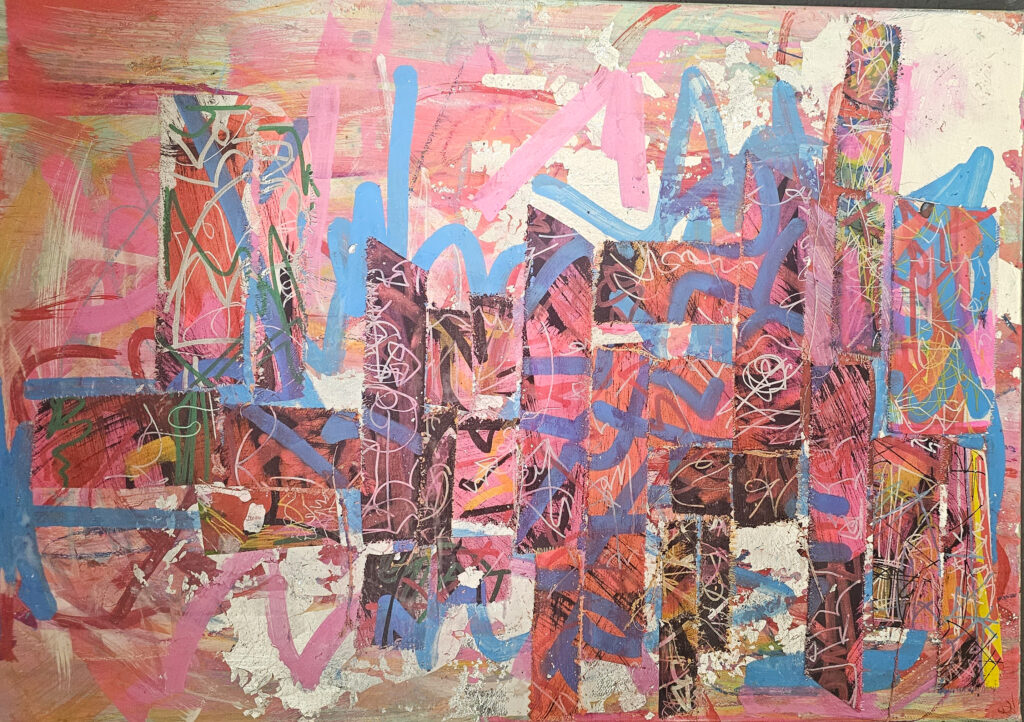
Reject Reflect Reclaim
Reject Reflect Reclaim invites visitors to critically engage with, and rethink, the narratives preserved within the Beecroft Art Gallery’s permanent collection.
Responding to selected works from the gallery’s archive of more than 2,000 pieces, we interrogated the collection and its notable absences. Our works sought to shine a light on overlooked voices and untold histories.
It was a real honour to be part of this show — and, as my TOMA experience has taught me time and again, to be among such excellent company in my talented cohort.
Aftermath
My piece for the show was an installation called Aftermath.
I responded to Percy Delf-Smith’s etching Thiepval after the Battles from the Beecroft collection.
My installation explores the desolation and fragility that war continues to inflict on both landscapes and the human spirit.
Aftermath is a meditation on violence, humanity’s destructive instincts, and the uncomfortable gap between the glorified rhetoric of conflict and the grim realities it leaves behind.
Constructed from manipulated paper artworks, the installation uses paper primed with chicory — a coffee substitute consumed in the trenches of the First World War — and softened with body lotion, creating a pliable surface for layered narratives.
Over this conditioned paper, black ink and ink powder are applied using an array of improvised tools: branches, feathers, teasels, ink-can pens, and traditional brushes. These evoke the environmental textures of Delf-Smith’s original work and nod to his use of gramophone needles in the etching process.
A Desecrated, Raw Landscape
The piece is also influenced by Jeremy Deller’s It is What It Is, where he toured a car destroyed in Iraq across the US. I wanted, in a similar spirit, to capture the destruction and brutality born in the ‘theatre of war’ — in a still, silent way.
The marks I created form painted landscapes, fragmented body forms, and cryptic asemic texts — visual elements that resist easy interpretation, mirroring the distortion of truth and meaning in war rhetoric and propaganda.
Layers of chicory and ink powder disrupt and transform earlier landscape compositions, creating a charred, decaying effect.
Nestled within the wreckage are my small, delicate paper sculptures — cadaver-like forms that embody vulnerability and the ephemeral nature of life. Shaped through folding, tearing, and wrapping, these fragile constructs are a visceral exploration of myth-making, misrepresentation, and the fractured ‘truths’ perpetuated during conflict.
Through its raw materiality, Aftermath invites viewers to reflect on the intersections of memory, destruction, and humanity’s struggle to reconcile past violence with present realities.
My Artist Colleagues
It would be remiss of me not to highlight some of my fellow artists’ incredible work. Every piece in the show was remarkable and thought-provoking. I’m sorry I can’t share everyone’s here, but here are just a few very edited highlights.
Mark Amura, Work?
Chanel Vegas, Untitled
Becky Buchanan, Ghosts of Cedar Forgotten
Majik, Portal
Jo Morrison, Wise As Serpents; Mary, Eve & Sophia with 331 Prayers.
Selena Chandler, Portrait of a Woman Brushing Her Hair
Nathalie Coste, Victory and Happiness.
The show runs from February until 11th May 2025 — plenty of time to visit if you haven’t already.
About TOMA
TOMA is an artist-run education model and exhibition programme based in Southend-on-Sea. It supports artists who have faced barriers accessing traditional art education and the broader ‘art world’. Through education programmes, exhibitions, and public events, TOMA fosters a friendly and inclusive space for the Southend community to learn, engage, and create.
Teenage Days of Discovery, Mixed Media on Canvas Board
I’ve recently been playing with collage.
I’m inhabiting my inner Lee Krasner who often tore old canvas work and reinvigorated them as tremendous collage pieces. I’ve taken this idea and mashed it up a bit. Well quite a lot actually.
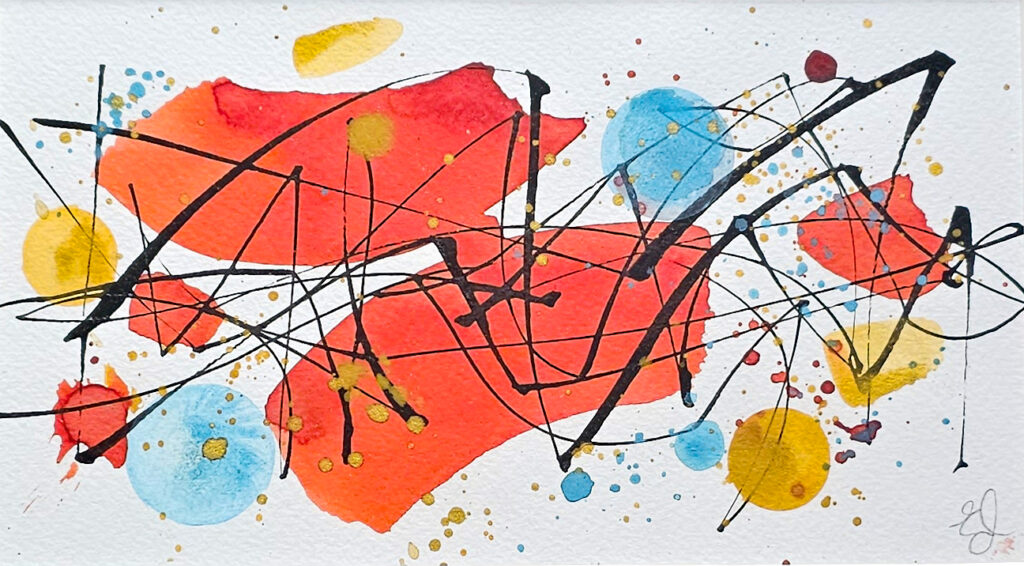
The process
Taking on my on-going fascination with the palimpsest, I took some canvas pieces and paper compositions I wasn’t happy with, tore them up and drew all over them with paint, permanent and metallic marker.
I then took some other canvas board and canvas pieces I’d already worked on and layered them with gold and silver leaf and wax paper. I then applied strips of my ‘customised’ canvases and paper pieces.
Once the layers were fixed, I made further marks using paint, crayon and marker to bring the pieces together.
The morning journey to school, mixed media on canvas
The purpose
These were artworks made in my recent past. I wanted the pieces to reflect my deep past. Ultimately my childhood. Traditional nostalgic artworks and memoirs about childhood are so often depicted in some kind of rural ideal.
I didn’t grown up in a rural setting. I grew up in Hackney. Just off City Road. In the 70s and 80s. I went to school in Hoxton and spend Saturdays down Hoxton or Chapel Street Market or Dalston High Street. That was my childhood landscape.
Memories of Home, mixed media on canvas board
I wanted these collages to reflect the eclecticism of this environment. The reflections of rain on pavement, the graffiti tags, the flora and fauna of the Regent’s Canal, the tall buildings, the quality of light. The noise and the silence.
I also wanted these pieces to be about love. So I took tremendous care in putting them together.
As the past is a construct. These pieces are deliberately fragile as I am an unreliable narrator. It’s just my memories. My sensations and my truth not THE truth.
They really deal with my journeys to and from places. I walked a lot in my childhood. We didn’t have a car. While we lived centrally we had a bit of a walk to Old Street tube and the Angel. There were a lot of long streets and canal meanders. And a lot of clashing architecture. And it’s those contradictions and juxtapositions I wish to navigate in these works.
I was really pleased with the show. Level Best Art Gallery is an exquisite space and it was wonderful to see my work and Wendy’s wonderful paintings in such a beautiful setting.
Collaboration
I enjoy working with other artists and have adored Wendy’s work for a while now.
Wendy is a pleasure to work with and I felt there was a meeting of minds as well as a synergy with our art.
Our pieces really spoke to each other at the show. Our love for abstraction and mark-making was evident. While our work is different, I felt there was a harmony in the show and a conversation was being had with the pieces.
My paintings and drawings at the show
Paintings by Wendy Fransella at Level Best Art Gallery.
The work I chose to display in this show is a deep exploration of mark-making, spontaneity and memory. The pieces are also a record of my interior thoughts and reflections on my own history and the lives of people that have influenced me. With this in mind I thought I’d give you my motivations and thoughts behind the individual pieces in the show.
Musical landscapes and hard remembered conversations
Musical landscapes
My small MUSICAL LANDSCAPES are miniature abstract music scores that reference asemic text and pay homage to the artist Victor Pasmore.
Half remembered conversations, paint on canvas
My HALF REMEMBERED CONVERSATIONS paintings further explore asemic mark-making and recall the vague dreams and plans I’ve made on hopeful sunny days.These pieces also referencethe calligraphic line seen in graffiti and are a reference to my urban upbringing.
Live generously
Live generously
Mylarge-scale piece,LIVE GENEROUSLY,is part of a series of homage paintings that seek to pay tribute to female trailblazers. These women have defied the expectations of their families, society, prevailing narratives and/or authorities to challenge conventional thinking.The series is a contemplation on the lives of these women.
Live generously painting
The layering of colours and mediums explores the many complexities and contradictions of their lives and the people they knew, as well as the scenes and political landscape that were part of. The pieces also visually reference military fatigues and camouflage, in light of the battles these individuals have fought.
The bats in the garden over lockdown, Centred in time and We are here now
Ella Johnston Level Best Art Gallery
I explore memory and love in THE BATS IN THE GARDEN OVER LOCKDOWN.Created in 2023, these pieces evoke a memory of looking out of the window during the pandemic with my partner.The brush strokes hope to evoke the sense of magic and wonder we had while watching the bats swoop for moths in the dusk.
The CENTRED IN TIME and WE ARE HERE NOW now ink on paper pieces are abstract tributes to nature and the mood evoked by a walk along a river, estuary or beach. Whatever the time of year, on any particular day, the meeting of sky, land and water can have a uniquely beautiful quality to it.
We are here now, ink on paper
These artworks perform as palimpsests, with layer after layer of ink colour being applied to the paper, saturating the surface and merging into another. With hues of navy, pink and black it aims to conjure a sense of the magical quality of the landscape as the day turns into evening.
Rave sounds of the reed warblers and I can hear the music travel
I can hear the music travel and We are here now at Level Best Art Gallery
My RAVE SOUNDS OF THE REED WARBLERS artworkis a remembered landscape. I created it using feathers found in Wivenhoe woods and teasels gathered from the Ferry Marsh along with tin-can pens and Japanese calligraphy brushes. I wanted to capture the feeling of looking over the Ferry Marsh and being in the space. It is created purely as a memory rather than a depiction.The hasty strokes and dynamic layering reflects the changes in movement and sound in the environment.
Rave sounds of the reed warblers, Ella Johnston
I CAN HEAR THE MUSIC TRAVEL is another remembered landscape inspired by memories of the Ferry Marsh. I wanted to reflect the drama of environment on a stormy day. The darkness of the skies, the choppiness of the water, the violence of the wind-blown reeds are all evoked here.
My current work is an exploration of mark making. The marks are a kind of text. Some of the pieces are specifically asemic. They are an exploration of the types of marks I make when writing.
This is actually very personal. Because of the way I held my pen when I was a kid, I was bullied by a teacher for my writing. Ever since then I’ve been strongly protective over my writing and my mark making. And it’s something that I’ve needed to explore. It’s something that I’ve had to think about from an early age – the marks I was making and how I was making them.
It’s quite a psychological thing for me. I like my writing. People comment on my handwriting. What is ‘my own hand’? What is it to play and experiment with that? Asemic poetry really interests me because it’s about making marks and enjoying these marks without actually writing a text that people can immediately read. But the visual language of handwriting can be found within my own artistic practice. I also once I had my handwriting studied by a graphologist. She noticed all the flourishes and was alarmingly accurate with her analysis. Regardless of what words you write, the marks you make give the game away. I employ all of my handwriting and gestural mark-making in the pieces.
The pieces are definitely wordless texts and there’s a dialogue between the different marks. But they’re also simply about being in the moment when the artwork is created. I might have my reflections or even a particular agenda, and it’s also in some ways a projection of the future, but really it’s simply about the moment, the now, in which the artwork is made. I don’t want to impose my own narrative. The question is just about what it means to make a mark, and to make those marks on the paper.
With different papers you get different reactions. I love the experiment of paper. The surface is as important as the ink or the paint. A cheap watercolour paper, made without bleach so it’s greyish in tone, produces a certain effect. Some papers absorb liquid too much, some resist it. A washi inkjet paper and a fine washi rice paper give different results. Some absorb the ink very quickly, some completely blot it.
With a very fine paper, you’ve got to be careful if you want a solid line. You’ve got to be light, like you’re barely touching the paper, because if you apply any kind of pressure or wetness, it’s going to suck it up. It’s really delicate. Or you might use a good quality, heavy paper, and they’re so dense, but they hold colour so well that you’re challenged to be decisive in the marks that you make. On some papers the black ink buckles the paper, it sits and stays shiny on it, raised in relief. Some papers can look so frail against this force of the black. You have to work with that. You’ve got to work with the ink and the paper as equally important components.
I have to let intuition guide me a little. If I use a square brush, I know that I want to explore something about form, with spontaneity and looseness. It involves memory and even muscle memory of making those marks.
Photography Nathan Jones
If I pick up a pen I know I want to be precise, when I use a particular brush I want to be expressive in a different way. I’ll know it instinctively when I start.
Then, once I introduce the colours, form and composition, I’ll know what theme it’s taking. It can almost be like you’re in a trance, a slightly different level of consciousness. I’m alert, and the marks I make are deliberate, but there’s also a flow, a dance, which you don’t have to think about, and it just happens.
If I’m holding a large square brush, how do I make that curve? How do I make those gestures, those swooshes and dashes that look like they’re moving even if they’re static? They’re still but they’ve got movement, like they’re about to fly. Or a mark that’s got to be so solid. I’m not thinking hard about it. If I’m too diligent it doesn’t work. I’ve got to be purposeful, but at the same time I’ve got to let go and be free. Focused but free.
I’ve always liked ink. I like the unruliness of it and that you’ve got options to use a pen or a brush, and to water it down to create washes. There’s a lot of scope.
In the past few years I’ve also experimented with different types of mark-making tools. I’ve used feathers, and reeds from the marshes near where I live, and broom, and the seed-heads of teasel. They make different types of mark. And there’s something more fluid about inks than paint when you make those marks. I like its immediacy, its unforgiving nature.
I use a lot of Japanese calligraphy brushes of different sizes, and square brushes, and I also make my own tin-can pens from old soft drinks and beer cans. They’re really a calligraphy tool but, like with the calligraphy brushes, I use them for drawing and mark making. I like the playfulness I can achieve with the tin-can pens, the variation of line, and when I combine that with the softness of a brush it’s quite interesting.
If I’m using soft round brushes, I might know that I want to press the full weight of the brush down and drag it. Or I might want to work with the tip of a calligraphy brush to produce very fine lines. With a tin-can pen you’re not going to get a consistent line. It doesn’t hold ink in that way. You don’t control it in the way you do with a brush.
I often use the tin-can pens to create a kind of central column in the work, which is a kind of upwards life force. There’s a journey there, a sense of collision and violence, but an upward momentum and force. The hard lines and edges of the pen strokes, in contrast to the soft lines of the brush produce collisions. Then I’ll add extra shapes, circles or blocks of colour. And in doing all this there’s a search for balance, beauty and harmony. There’s a mood. It’s a mood of stillness and movement and the contrast between them.